
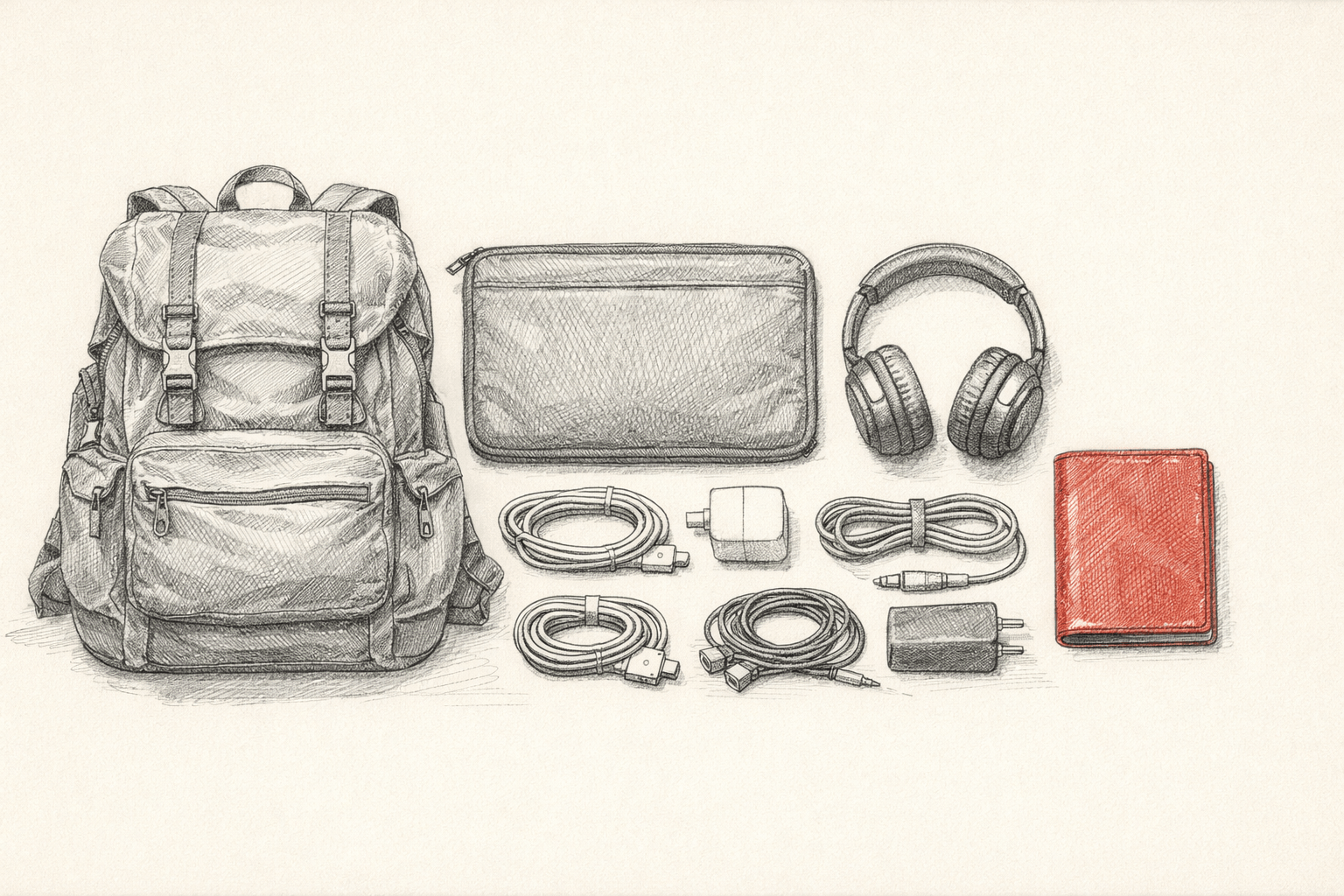
In shortMy Tumi backpack has done nine years at roughly 100k miles and 100+ flight segments a year, which works out to about 900 flights on one sub-$100 repair. Gear splits across three lines, from what is on my body out to a suitcase for several days away. Travel routers and neck pillows never make the bag. And I carry quarters, because an air pump outside Washington took coins and nothing else.
A Decade of Use and Failure as a Cyber Executive
I’ve spent the last decade on the road as a cybersecurity executive, where missed flights, dead batteries, and broken gear have real consequences.
What follows is a candid accounting of the gear that has survived a decade on the road. Every item here has been carried, broken, repaired, replaced, or discarded under real travel conditions, and selected because of real-world situations.
If you follow r/BuyItForLife, you know the philosophy - buy once, buy well. This is that philosophy applied to executive travel.
The day I had everything, except a quarter

Despite all the tech I carry - two phones, multiple SIMs, satellite capability, travel router, offline backups - I still found myself on a back road outside Washington, D.C., with no cell signal, no Wi-Fi, and a flat tire, a deflated spare tire in the trunk, and no way to fill either.
I'd managed to limp to a gas station - closed, but maybe there was an air pump I could use... Nope! Cash only.
The irony? I was less than 30 minutes away from meeting an executive at one of the oldest, most prestigious consulting firms in the world. A Tier 1 city. A high-stakes meeting. And I was standing next to a rental car, alone, trying to find an air pump… that only accepted coins.
No app. No tap. No Apple Pay.
That moment crystallized something for me: all the digital layers, backups, and platforms I rely on are only as useful as the lowest-common infrastructure beneath them. It’s why I carry a flashlight. Why I pack backup SIM cards. And why, from that day forward, I started carrying quarters.
Because when failure happens, it doesn’t always happen in hostile territory or halfway across the world. Sometimes it happens in a world capital, an hour from the Pentagon.
Who This Guide Is For
I wrote this for white collar workers who travel frequently for business to developed countries. Think North America, Western Europe, Japan, Australia. If your travel looks like airports, hotels, offices, government buildings and boardrooms, this applies. It could be sales reps, management consultants, company executives.
Who this is for
- Frequent business travellers
- Mobile tech workers
Who this is not for
- "A-conference-a-year" workers
- Ultralight backpackers
- One-week vacation travellers
- People optimizing for Instagram
CAUTION: This content explicitly does not cover travel to hostile environments. That includes countries with well-known cyber risk profiles like Russia or China, places with high violent crime like Mexico or Colombia, or environments saturated with adversarial hackers like DEFCON in Las Vegas.
Two Decades of Business Travel Experience
My bona fides for talking about travel come from experience:
- I have been traveling internationally for over 20 years on trips that push beyond comfortable itineraries and polished infrastructure.
- For the past decade and a half, I've been a tech executive traveling internationally and have logged over 150,000 miles a year, 100+ flight segments, and more than 100 days on the road
- I work in cybersecurity and regularly visit secure facilities where radios and electronics are restricted, but still need to remain productive.
- I live in Victoria, BC on Canada’s west coast, where travel routinely involves small regional jets, float planes, ferries, and helicopters, all of which impose real constraints on what gear and systems actually survive the journey.
- Outside of work, I travel to places further afield: the Arctic for polar bear photography, minefield-adjacent temples in Cambodia, Myanmar during military junta rule, and salt mines in the Andes on horseback.
- I test and refine my approach through repeated failure and iteration, on my own time and at my own expense.

How I Evaluate Durable Business Travel Gear
I travel often, usually with tight schedules and real consequences for being late or offline, and need to be productive regardless of where I am in the world. This is written from that reality, not from leisure travel or once-a-year conference trips.
I buy gear to survive long flights, bad weather, oversold planes, tight connections, and meetings where being late or underprepared has real consequences. Aircraft size limits, overhead bins, repairability, and failure modes matter more to me than an idealized packing list.
The principle is always the mission. I take bits and pieces from everyday carry (EDC), buy it for life (BIFL), r/OneBag, ultralight backpacking, tactical and modular, digital nomad, and stealth wear, but I treat them as inputs rather than identities. Each school has something useful to borrow, provided it survives contact with real travel and real work.

From those camps, here is what actually made it into my kit:
- From EDC, the discipline of assuming what is on me is all I have for the next several hours.
- From BIFL, an intolerance for disposability and a long memory for how things fail after repeated use.
- From r/OneBag and UltraLight, respect for weight, volume, and friction moving through airports, taxis, and hotels.
- From Modular systems, reduce decision fatigue so that re-arranging gear requires less thought, and moving just kits between bags
- From Digital Nomad setups, the assumption that work happens anywhere, often sooner than planned, and rarely with ideal infrastructure.
I lean into BIFL thinking because I have broken enough cheap gear in transit to understand the real cost. Not the replacement cost. The time, distraction, and reputational tax that shows up when something fails at the wrong moment.
Travel light, but prioritize Mission and resiliency over minimalism
I carry the least amount of gear that still lets me operate if any single item breaks, gets lost, or walks away. One failure should be annoying, not mission ending. For example:
- Two sets of headphones, because one pair is easily lost.
- Two phones (on different platforms), because borders, carriers, and batteries are unreliable, and sometimes niche software only works on one platform
- Laptop and iPad to maximize productivity regardless of the situation.
This setup could be reduced by stripping out the "just in case" items, but I choose not to. Cables and medications are easy to buy locally, but time isn’t always available, or stores may be closed. Taking an hour to find cold medicine or the right dongle can derail a day of meetings, or push work into the evening. An ounce of preparation is worth a pound of cure.
I plan for real world disruptions. Delays, border issues, outages, payment networks going down, sudden reroutes, and the occasional geopolitical surprise. This comes from experience being stuck in airports, train stations and locked down in hotel rooms.
Best Luggage for Frequent Business Travel

I have steadily gone down in suitcase size over the years, aiming to reduce bulk and weight. Brands like Briggs & Riley have set the standard with unconditional lifetime warranties, but my own testing has led me in a different direction. My travel usually involves multiple legs in a hub and spoke system, which means smaller commuter jets or props at one end of the journey. When a flight is oversold, I do not have status, or a delay puts me at the gate late, the option to slide a bag under the seat matters. Backpacks can usually be jammed somewhere. A slim underseat roller buys flexibility when overheads are gone.
"Take less stuff and more money and you will be happier."
Best Carry-On for Business Travel: July Carry-On Light
I started with a rollerboard from Mountain Equipment Co-op that is long discontinued. My MEC roller survived 5 years and ~500 flights before I moved on - it was simply too big, and the soft material wasn't ideal compared to a hardshell. But it lasted a long time and was tremendous value for money, at ~$100.
July Carry On vs. Away Carry-On
I travelled using the Away Daily Carry-On with Pocket from Away Travel for about four years - good, but not great. It had the right volume, but was too thick and stubby. After considerable research, I landed on the July Carry On, which so far has fit everywhere I've taken it.
Best Travel Backpack for Executives: Tumi Alpha Bravo Knox
My Tumi backpack is true BIFL. It has been to dozens of countries and climates, from atmospheric rivers in the Pacific Northwest rainforest to winter in Scandinavia to Las Vegas in August. It has been crushed into overheads, luggage racks, and train bins for nine years at roughly 100k miles a year - that’s ~900 flights and counting.
Eventually the breathable padding started to fray. A sub-$100 repair brought it back to life. That is what durability looks like in practice. "If it cannot be repaired, it is not really durable."
Best Travel Shoulder Bag: Waterfield Musette

I go back and forth on a shoulder bag versus relying on a backpack. The decision usually follows the room. The more executive the meeting, think government ministers, Fortune 500 leadership, pension funds, the less likely I am to walk in wearing a backpack. Trade shows, conferences, or long marketing days on foot in Vancouver, Toronto, or New York flip that logic entirely.
I like the ethos and build quality of Saddleback Leather. I carried my Saddleback for 8 years - I have owned the original briefcase and then moved to the thin briefcase. It remains heavy even before you load it, and loaded it is punishing. The fact that the shoulder strap converts into a backpack tells you how often owners need relief.
As a rule, leather is a poor travel material. It's heavy, expensive, doesn't seal completely and not a good travel choice. But in the words of a famous adventurer:

"Leather as a travel material sucks: it's heavy, bulky, lets in dust and water. But there's nothing cooler than a leather bag that's been around the world a few times."
Robert young pelton
The bags from WaterField Designs strike a better balance between leather and synthetics. Three years in, my Waterfield shows zero wear - they travel lighter and make fewer compromises. Time will tell whether the patina matches what Saddleback develops, but functionally they are easier to live with on the road.
How I Pack and Organize Gear for Business Travel
The Three-Line Packing System: Borrowing from Tactical Culture
I distribute gear across three lines, borrowing directly from tactical and preparedness culture, where load is deliberately split to match time horizon and failure tolerance. The point is not cosplay or maximalism. It is to stay functional when plans break.
- First line. On my body. EDC. Operate for the day.
- Second line. A small pack or day bag. Operate for roughly 24 hours and handle disruptions.
- Third line. A larger bag or vehicle loadout. Operate for several days if needed.
This framing forces clarity about what truly belongs where and prevents everything from ending up in one overstuffed bag.
Modularity makes this workable. Shaving kit, cable kit, apothecary kit. The same modules move between bags depending on the trip. Short travel means the suitcase stays home and the kits move into the backpack, without revisiting every item.
My bias is toward quiet, professional gear that works, blends in, and survives abuse. Everything here is bought, used, and evaluated based on performance in transit and at work.
Business Travel Packing List That Survived a Decade
1st Line: Every Day Carry (EDC)
In a pinch - have comms, cash and ID to get on a flight and get home, even if everything else was lost. 1 item per pocket

- Wallet
- Minimum 3x credit cards
- American Express
- Visa
- Mastercard
- ATM card(s)
- Cash
- 2 IDs (drivers license + Nexus or Passport)
- Minimum 3x credit cards
- Keys
- Yubikey,
- Pill container
- iPhone
- Samsung Galaxy Flip
- Wedding ring
- Airpods
- Smart Watch
- Extra layer of clothing (eg. Jacket, vest, sweater)
Alternate EDC for secure offices, government buildings
Sometimes locations will prohibit electronics.
- Wallet
- Mechanical watch
- Wedding ring
- Keys
- Fieldnotes + pen
- Challenge coins
2nd Line: Carry on Bag
Also known as a "go bag". In a pinch - can be productive for a few days, and get home.
- Tech for Travel
- Macbook optimized for screen size and weight (I’m very rarely doing heavy data or analytics work locally anymore)
- iPad for use as note taker, and secondary screen.
- Apple Wireless keyboard
- Apple Wireless mouse
- Power Bank
- Airplane Ergo Kit:
- Roost Laptop Stand to get laptop up to eye level
- Mountie for clipping iPad to top of laptop)
- Pair of Hooks for mounting iPad on back of airplane seat to save my neck and stay productive on flights
- Apothecary kit
- Antihistamine
- Anti-nausea (Dimenhydrinate)
- Anti inflammatory (Acetaminophen, Ibuprofen)
- Decongestant (pseudoephedrine)
- Daily medicine (eg. antibiotics)
- Hand sanitizer
- Lip balm
- Cable Accessories kit
- USB C
- USB A
- Lighting
- HDMI <> USB C adapter
- Pill container with
- SIM cards
- USB thumb drive
- USB adapters
- Canadian flag pin
- SIM card tool
- Safety pins
- Metal collar stays
- Cold weather accessories
- Toque
- Gloves
- Wool Buff
- Money & documents
- Cash ($200 - $500), mix of currencies (CAD + USD) and denominations, including coins
- Credit cards
- Backup credit card
- Prepaid USA VISA card
- Add to Apple Pay as backup
- Passport
- Business Cards
- Travel Gadgets
- Flashlight to check for bed bugs and deter any late night encounters
- Field notes
- Collection of unique pens
- Cheap Umbrella
3rd Line: Suitcase (at your hotel/airBNB/safehouse)
In a pinch - can be productive, professional and functional in an extended disruption - such as a volcano erupting in Iceland, or a sudden outbreak in hostiles in Israel.
- Clothing System
- 1+1 pants
- 2 - 4 shirts/boxers/socks (depending on travel length)
- sweater/light jacket (usually warm)
- rain/heavy jacket (for winter)
- Emergency cold weather (buff/gloves/toque)
- Toiletries and shaving kit
- Philips Razor One and charger
- Hotel Power kit
- Universal plug adapter
- Apple wall wart with 2 USB C Plugs
- USB A > USB C cable
- Multi-day medical kit:
- Drinking straw
- Rehydration packs
- Cold medicine
- Extra daily medicine
- Mucex
- Eye drops
- Cough drops
- Other medication (eg. anti-malaria)
- Emergency kit
- Cash
- Credit card
- Passport photocopy and expired backup
- Hotel room security strap
Travel Gear That Didn't Make the Cut
There are common travel gear recommended that don't make sense. In no particular order, here are things to avoid packaing
- Travel wifi router: Unnecessary
- Solar panel: Already pack enough battery capacity, can battery life between devices in a pinch
- Travel towel: Get a tower from the hotel
- Luggage locks: Aim to keep your luggage with you at all times, instead
- Neck pillow: Bulky, personally find they overheat your neck
- Consumer VPNs: Not worth the risk trade off to funnel all your internet traffic to a third party
Why Most Travel Gear Fails (And What to Buy Instead)
Most of my gear gets dropped before it actually breaks. If something is redundant or never gets used, it’s just ballast and gets removed once a year after reviewing. What’s left still has to survive the real world, where things crack, disappear, or quietly stop being useful.
How gear actually fails on the road:
- Redundancy creep - More than two ways to do the same thing
- Wishful packing - Stuff that sounds smart but never leaves the bag (hello, travel towel)
- Breakage - Screens crack, connectors loosen, bags take hits
- Loss - Headphones gone, cables left in hotel rooms, small items vanish between legs
- Obsolescence - Adapters and accessories hanging around years after the tech moved on
How My Travel Gear Evolved Over a Decade

How my travel gear has evolved
Gear has evolved over the last decade, with a blip over COVID temporarily reduced travel, and gear lasted longer simply because it was not moving. That changed sharply in 2023 when travel ramped back up.
By 2024 and 2025, replacement cycles accelerated. Gear was worn out, damaged, or lost. My beloved Shure in-ear headphones - ten years of concert-quality audio - disappeared during a plane connection in 2025 somewhere in the ‘mile high airport’ in Colorado.
“Performance is irrelevant when recovery is impossible.”
Business Travel Clothing System: Layers Over Labels

Clothing shifted as the room changed. What started as “tech bro chic” gradually moved toward more conservative business dress as the people across the table changed. Government ministers, Fortune 500 executives, flag officers. Hoodies are no longer acceptable.
Layering remain key. A wool sweater and vest can stand alone or disappear under a jacket depending on climate and setting. On any given trip, a 30 degree Celsius swing is normal. Cold northern cities to desert heat. Central Europe to Scandinavia. The system has to stretch without looking improvised.
Shoes followed the same pattern. Red Wing Iron Rangers are outstanding once broken in - three years of mine felt like meeting some old friends for a drink. The problem is metal detectors: The metal shank guarantees means you have to take them off at security, and the speed benefit from using TSA PreCheck is made moot. Because of that, I’ve switched to a Chelsea when flying.
What Travel Gear Is Really BIFL (Buy It for Life)
BIFL - buy it for life - means choosing gear that survives years of abuse rather than replacing it every season. The Carryology BIFL gear guide captures the philosophy well. I buy into it where the gear proves itself under repeated use, travel abuse, and indifference to cosmetics. Some items have simply refused to die.
- Mountie laptop mount. Ten years and counting - reinforced with tape at the stress point, still going.
- Apple Magic Keyboard. Roughly ten years old.
- Apple Mouse. Over 11 years old - predates my tracking, still functional (though keys are worn down).
More or less, quality has upgraded over the years and becoming more BIFL. For example, Patagonia + Lululemon apparel, Tumi backpack.
There’s an exception: For the short lived and easily lost items (watch, flashlight, umbrella, etc) or things that will take abuse (eg. Suitcase), I prefer cheaper versions and which I expect to replace over time.
Staying Productive on the Road: Ergonomics Setup
My coworkers shouldn't notice if I'm working from my home office, an office or the road.

I am heavily invested in the Apple ecosystem, including a MacBook, iPad, iPhone, and AirPods. Having both a MacBook and iPad ensures productivity regardless of environment: iPad can be paired with keyboard in a pinch, or used with stylus. (I also run a local AI agent stack on a Mac Studio, same ecosystem, different use case.)
Off-platform backups with an Android phone ensure compatibility with niche apps, and as backup to a rogue Apple update or security issue.
Ergonomics are key for long working sessions. Carrying a Roost laptop stand (six years of daily use), a Mountie for my iPad, and a few hooks for front of airplane seats means I can always get a screen to eye height without accumulating neck or back strain, regardless of where I'm working.
What's Changed in 2026
- Testing the Sony XM4 noise cancelling headphones. Have held off for a long time because I didn’t like the bulk.
- I’ve been on and off smart watches, trying a new android watch that has a 1 week+ battery life between charges. Does basic fitness tracking and passes notifications from my phone
- Removed a raft of old cables, including an original iPod 30-pin cable

Frequently Asked Questions About Business Travel Gear
What luggage do executives actually use?
After a decade of testing, I carry three bags: a July Carry-On Light roller, a Tumi Alpha Bravo Knox backpack (nine years and ~900 flights), and a Waterfield Musette shoulder bag. The July replaced an Away Carry-On after four years - it’s slimmer and fits in regional jet overheads. The Tumi has been to dozens of countries and was repaired once for under $100. These aren’t status items - they’re tools that have survived real business travel conditions.
Is expensive luggage worth it for business travel?
It depends on how you calculate cost. My Tumi backpack over nine years works out to roughly $50 per year - far less than replacing a cheaper bag every two years. The real cost of cheap luggage isn’t the price tag, it’s the broken zipper before a client meeting or the wheel that fails in a connecting airport. Brands like Briggs & Riley back this up with unconditional lifetime warranties. For frequent business travelers doing 50+ trips a year, investing in durable luggage is a straightforward financial decision.
What is BIFL travel gear?
BIFL stands for "buy it for life" - a philosophy that values durability, repairability, and long-term ownership over disposable consumption. The r/BuyItForLife community on Reddit is a good starting point. In the context of business travel gear, BIFL means choosing items that survive hundreds of flights, can be repaired when damaged, and don’t need replacing every couple of years. My Apple Magic Keyboard (~10 years), Tumi backpack (9 years), and Mountie laptop clip (10 years) are proof the philosophy works. For more examples, see Outside Online’s guide to BIFL travel gear.
How do you pack for a week-long business trip with one bag?
I use a three-line packing system borrowed from tactical culture: First line is EDC (every day carry) - wallet, phone, keys - enough to get on a flight and get home. Second line is a day bag with laptop, iPad, cables, and medications - enough to be productive for 24 hours. Third line is the suitcase with clothing and extended supplies. This system forces you to distribute gear by time horizon rather than category, so losing any one bag doesn’t end your trip. I pack clothing as layers - one system that works from a 30°C boardroom in Texas to a -10°C government building in Ottawa.
What travel gear should you NOT buy?
Based on a decade of testing: travel Wi-Fi routers (unnecessary with modern phone hotspots and dual SIMs), solar panels (not needed with sufficient battery capacity), travel towels (just use the hotel’s), luggage locks (focus on keeping luggage with you instead), neck pillows (bulky and they overheat), and consumer VPNs (the risk of routing all traffic through a third party isn’t worth it). The common thread is that these items solve problems that better planning eliminates entirely.
What Do You Carry?
This is what works for me over the last decade and a half, but everyone’s setup is different.
If you’re a frequent traveler, what gear or systems do you trust most?
What would you add or cut from this kit?
I’d love to compare notes. Drop a comment, send me a message, or connect with me on LinkedIn.
--ILP